Megaprojects and Delays
Lately, it seems that every interesting megaproject is getting delayed. I thought it would be interesting to try and plot them, to see if we can understand anything from it.
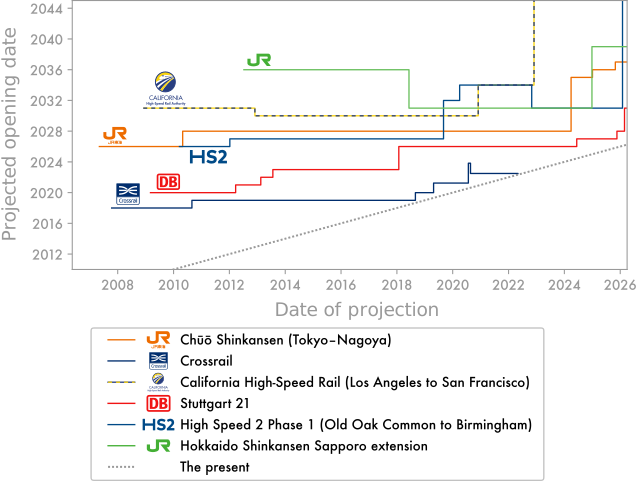
On the graph above, you see the most recent projected opening date for six rail megaprojects, as a function of the date at which we look for the projection. The projection jumps up when a delay to the projected completion is announced, and down when a new projection brings the estimated completion closer. The dotted diagonal line shows “the present”: if another line were to meet this, then the project would be overdue without announcement.
The projects
I’ve picked six projects that I have a decent amount of interest in. This obviously introduces sampling bias, but I’m not claiming to be scientific here, so forgive me this.
A full history of each project, including all of the flaws in its management, is also beyond what I can cover here; instead, I’ll focus on the specific, immediate causes for each announced delay.
Crossrail
Crossrail was the project to build what would become the Elizabeth line1. This is already complete, but I thought it would be useful to include as a benchmark.
The initial projection in 2007 was that the line would open by the end of 2017. In 2010 this was delayed by a spending review, which found that it would be cheaper to open it a year later, by the end of 2018. The projection stayed here for an incredibly long time, until the line was only months away from opening, when in April 2018 it was announced that the line wouldn’t be ready. There were repeated roughly one-year delays over the next couple of years2, a brief period where it was announced that it wouldn’t open until the 2023–24 financial year, before the final opening date of 2022-05-24 was announced, which was when the railway finally opened.
- Total delay: 4.5 years
- Delay causes:
- Funding reduction
- Problems with systems integration and testing
With the warm-up done, let’s discuss the remaining ones in chronological order of when the first projection was made.
Chūō Shinkansen
In April 2007, JR Central announced that the first leg of the Chūō Shinkansen ultra-high-speed maglev service from Tokyo to Nagoya would open by the end of 20253, with the Nagoya–Osaka leg following once funding stabilised to allow them to fund it without too much debt burden. Three years later, due to falling profits, JR Central announced that the completion would be delayed, as the pace of work would be reduced to match their available budget.
The design, permitting, and construction mostly proceeded, but there was a contentious issue around permitting for Shizuoka prefecture4. Despite construction being many years late starting there, it was only in 2024 that JR Central announced that they would not be able to meet the projected 2027 date, and instead that they were targeting 2034 at the latest—a seven-year slip.
Two more one-year delays have since been announced at intervals of ten months. In each case, JR Central stress that the date is the latest projected; however, the continued pushing back of this projection does not raise optimism of completion being significantly earlier. The permitting issues in Shizuoka appear to now be resolved, so let’s hope that the pace of delays will decrease.
- Total delay: 11 years (and counting)
- Delay causes:
- Funding reduction
- Environmental permitting
California High Speed Rail
In 2008, California High-Speed Rail was authorised, and charged with delivering a 160-minute San Francisco–Los Angeles connection, as well as connections to San Diego and Sacramento. The projected completion date for the whole project was the end of 2030.
In 2012, the project was restructured to prioritise the former connection, with anticipated completion of that now in 2029. Subsequently, uncertainty around funding led to priority being given to an “initial operating segment” (IOS) from Merced to Bakersfield, with the completion of the SF–LA connection pushed back to 2033 as of 2020. In 2022, this was pushed back again, now indefinitely, due to no clarity on whether the sections beyond the IOS would be funded at all.
Given that Merced and Bakersfield are not the major population centres that San Francisco and Los Angeles are, I strongly hope that the full line can be completed, rather than the IOS being seen as a white elephant showing that HSR can’t work in America. This would be an even worse outcome than if High Speed 2 in the UK ends up being constrained to London–Birmingham (see below).
- Total delay: unknown; potentially infinite
- Delay causes:
- Funding restriction
Stuttgart 21
Stuttgart 21 is an ambitious project to modernise the long-distance rail network through Stuttgart for the 21st century. Indeed, as planning started in the 1990s, the “21st century” is what the “21” in the name stands for (not a missed deadline of 2021). It includes high speed approach lines to Stuttgart, new approach tunnels, and a new underground through station, replacing the current terminus station.
The first opening date projection that I can find is from 2009, where opening was projected for the end of 2019. In 2012 and 2013 this was adjusted to 2020 and 2021 respectively, for reasons not immediately clear, but then by later in 2013 the steering group was instead quoted as saying that there was only an 80% chance of completion by 2022. This estimate held until 2018, when completion was pushed back to 2025. This projection lasted a full six years, but only 18 months before the estimated completion time, it slipped again, as through 2024 and 2025 the completion time was pushed to 2026 and then 2027. In each case, the projection started off being for project completion, before being softened to a gradual opening starting in the given year. In February 2026, the project gave up with one-year extensions, and indicated that the project would not be completed before 2030, without committing to a firm upper bound.
Initially there was a lot of local opposition to Stuttgart 21, but this doesn’t seem to have had a significant impact on the construction, having largely been sorted before construction began. I haven’t dived that deeply into the German press around the issue to identify other possible causes for the delays.
- Total delay: 11 years (and counting)
- Delay causes: Unknown
High Speed 2
High Speed 2 (HS2) is the first “real” high-speed line in the UK. (High Speed 1 is a link to the Channel Tunnel; while it is used by domestic services, these do not provide the sort of high-speed intercity service one expects from a high-speed railway line, except for trains leaving the UK to continental Europe.)
HS2 was promised by the outgoing Labour government in 2009, and the proposal taken forward by the coalition Conservative-Liberal Democrat government in 2010, who committed to a Y-shaped network from London to Birmingham, then branching to Crewe and Manchester to the west, and towards Leeds to the east, with some services continuing along conventional lines towards Scotland from both. Delivery was planned by 2025.
In 2012, the plans were finalised with two phases: the first from London to Birmingham and the West Coast Main Line, and the second to points north. The delivery timeline for phase 1 was pushed back to 2026, with phase 2 to follow later.
The process then largely stalled for five years, with the parliamentary bill authorising construction only passing in 2017. Meanwhile, phase 2 was split into two parts, with the first (phase 2a) starting to go through parliament the same year (to eventually pass in 2021), and phase 2b to follow (or, ultimately, not yet). Only two years later, in 2019, the completion estimate for phase 1 was pushed back to 2031, to coincide with phase 2a.
In 2020, this timeline was pushed back to 2033; one might blame COVID for this, but the timing seems slightly too early, having been at the beginning of April. In 2022, this was actually brought forward to 2030, at the expense of not being the complete phase 1, but rather the stretch from Old Oak Common to Birmingham (and, we presume, the West Coast Main Line), with the final leg to central London to follow later (probably). Not long afterwards, both parts of phase 2 were summarily cancelled by the Prime Minister (with questionable legality).
When the Labour party took power in 2024, the project was seen (by journalists and politicians alike) as a money pit, and the delays viewed as due to mismanagement. Efforts have been made to impose more political control. In 2026, all commitment to a completion date was withdrawn, subject to a “reset” being performed with new management, who are to produce a revised timeline; as such, there is currently no projection for completion. It is seen as likely that the completion date will slip further backwards5.
- Total delay: 5 years (as of 2022)/indefinite (as of April 2026)
- Delay causes:
- Politics6
Hokkaido Shinkansen to Sapporo
The Hokkaido Shinkansen is an extension of the Tōhoku Shinkansen to Hokkaido, bringing high-speed rail to the island for the first time. The first phase through the Seikan Tunnel to Hakodate opened in 2016; the original Shinkansen Basic Plan called for the line to continue via Sapporo to Asahikawa. Currently only the stretch to Sapporo is under discussion; even Japan’s famously large and well-performing high-speed rail network falls short of the designers’ original aspirations.
In 2012, while the first phase to Hakodate was still under construction, it was announced that the second phase would be completed by 2035. Surprisingly, in 2018 this was brought forward to 2030, with no reason given in sources I’ve read. However, in 2024 this was pushed back to 2038, due to the difficulty of tunnelling on the planned route.
- Total delays: 3 years (relative to original plan)/8 years (relative to most optimistic estimate)
- Delay causes:
- Underestimate of tunnelling difficulty
Conclusions
It seems that a wide range of major rail infrastructure projects has difficulty keeping to projected timelines. Crossrail, despite the embarrassment of the late notice of delays, ultimately was not very far past its original estimate–five years, or 50% of the planned construction time. Other projects are seeing more substantial delays, some of a decade or more, and especially in the most recent couple of years.
Sadly, it seems unlikely that any of these projects will be completed by 2030, despite all of them having at some point been planned for this.
-
Or the Elizabeth line of the Elizabeth line… Don’t ask, it’s a whole thing. ↩
-
As the project failed to get a handle on signalling problems, as I understand it. ↩
-
Initially planned to start at Tokyo station, this was revised in 2008 to be Shinagawa station instead, due to the astronomical cost of the final few kilometres of tunnel through Central Tokyo. ↩
-
Reportedly, although my Japanese isn’t good enough to follow the reports in detail, there were other delays across the line, but given that civil engineering works were at least progressing, it seems less likely that they were on the critical path. ↩
-
Of course, the lack of commitment to the subsequent phases means that the costs of recruiting and training apprentices will not be amortised across the larger project. Instead, they will leave their current organisations, and should phase 2a and 2b go ahead (in any form), then new recruitments and supply chains will be needed, escalating the cost and increasing the time to completion. This is, of course, the cycle of “boom and bust” that every government claims to want to avoid, but seems unable to avoid recreating. ↩
-
Some will claim that I mischaracterise this. However, as stated at the top, I am not attempting to deep dive into every project, but looks specifically at each instance of a delay announcement, and attempt to attribute causes. In each case of delay to HS2, it coincides with or follows from a significant political intervention: the slow hybrid bill for phase 1 in 2017 that did not allow adequate planning to understand the timescales and meaning that by 2019 it was clear that things were running very late; altering the scheduling of work relative to phase 2a in 2019; reversing this in 2021 leading to significant uncertainty in 2022; the Labour government taking over in 2024 and making significant political directions of the project into 2026. ↩