The EC plan to accelerate high-speed rail across Europe
Today, the European Commission released its plan to accelerate high-speed rail across Europe. I haven’t read the document, but have read Jon Worth’s analysis of it. In it, Jon raises confusion over the categorisation of the various, seemingly arbitrarily-chosen connections. I decided to sit down and get them into a spreadsheet to see if I could make any more sense of them. (Not because I think I can do better than Jon at railway analysis, of course; I just like an exercise in putting train numbers into spreadsheets.)
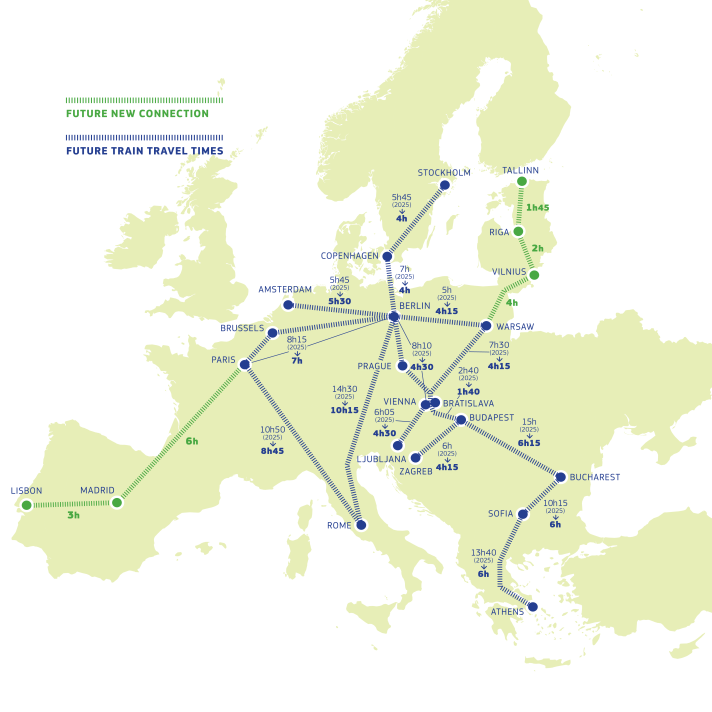
| Station 1 | Station 2 | EC Report Description | “Current” travel time | “Future” travel time | OpenRailRouting time | Interrail Planner time | Number of changes | Services per day |
| Lisbon | Madrid | Future new connection | 3h | 5h16m | 8h39m | 2 | 1 | |
| Madrid | Paris | Future new connection | 6h | 10h13m | 9h57m | 1 | 2 | |
| Paris | Rome | Future train travel times | 10h50m | 8h45m | 10h3m | 10h11m | 1 | 2 |
| Paris | Brussels | Future train travel times | 1h22m | 0 | 25 | |||
| Paris | Berlin | (Solid line) | 8h15m | 7h | 7h53m | 8h8m | 0 | 1 |
| Brussels | Berlin | Future train travel times | 6h38m | 1 | 10 | |||
| Amsterdam | Berlin | Future train travel times | 5h45m | 5h30m | 4h56m | 5h51m | 0 | 6 |
| Copenhagen | Berlin | Future train travel times | 7h | 4h | 5h47m | 7h49m | 1 | 5 |
| Copenhagen | Stockholm | Future train travel times | 5h45m | 4h | 4h30m | 5h30m | 0 | 1 |
| Berlin | Prague | Future train travel times | 4h27m | 0 | 6 | |||
| Berlin | Vienna | (Solid line) | 8h10m | 4h30m | 6h51m | 8h35m | 0 | 2 |
| Berlin | Warsaw | Future train travel times | 5h | 4h15m | 4h13m | 4h58m | 0 | 6 |
| Ljubljana | Vienna | Future train travel times | 6h5m | 4h30m | 4h31m | 6h1m | 0 | 1 |
| Vienna | Budapest | Future train travel times | 2h40m | 1h40m | 2h9m | 2h37m | 0 | 21 |
| Zagreb | Budapest | Future train travel times | 6h | 4h15m | 4h43m | 9h46m | 2 | 2 |
| Budapest | Bucharest | Future train travel times | 15h | 6h15m | 9h38m | 17h26m | 0 | 2 |
| Warsaw | Vilnius | Future new connection | 4h | 5h | 8h34m | 1 | 1 | |
| Vilnius | Riga | Future new connection | 2h | 3h35m | 4h9m | 0 | 1 | |
| Riga | Tallinn | Future new connection | 1h45m | 4h19m | 6h20m | 0 | 1 | |
| Sofia | Bucharest | Future train travel times | 10h15m | 6h | 6h30m | 10h42m | 3 | 1 |
| Athens | Sofia | Future train travel times | 13h40m | 6h | 8h4m |
In the table above, I list:
- The two stations on a given connection
- The categorisation in the EC map. Two links, Paris–Berlin and Berlin–Vienna, are marked with thin solid lines rather than either of the line styles in the legend. I presume that this means that intended route is along the intermediary dashed lines, but this isn’t clear.
- The “Current” and “Future” travel times shown in the map
- The current best possible time using the available infrastructure, as reported by OpenRailRouting. (This assumes instant acceleration to line speed, so in principle gives an absolute lower bound on the journey time, rather than anything achievable.)
- The current best possible time on a cursory timetable search for today, using the Interrail Planner app
- The current number of connections per day on the route, ignoring sleeper trains
There are a couple of options for how these categorisations are intended to be read, but let’s go through each in detail before summarising at the end. I’ve listed them in roughly west–east order.
The Routes
Lisbon–Madrid
I’ve assumed that this means Lisbon Oriente to Madrid Puerta de Atocha. Currently this is a somewhat (unnecessarily) arduous journey, taking almost nine hours and two changes, with only one connection per day available. In principle, a journey time closer to five hours would be possible with the current infrastructure, but there’s little interest in making this happen. There have been on-again-off-again plans to build high speed rail along this corridor for decades, but last week a new plan was announced, giving a concrete schedule and targeting a sub-three-hour connection by 2034, and using standard gauge tracks end to end (avoiding the need to change train at the border). In the mean time, the first section of HSR on the route is due to open very soon, allowing some reduction in journey time this decade.
Madrid–Paris
The current journey time, going via Barcelona, is a hair under ten hours at best, with two trains per day. (For whatever reason, OpenRailRouting doesn’t recognise this route, instead preferring the route via the Basque country, with a minimum journey time of 10h13m.)
There are two separate projects relevant to this route:
Both projects aim to give a through connection Paris–Madrid in under six hours, presumably the origin of the number shown. Neither project appears to have broken ground yet; both are due to have phases complete by 2034, but neither is due to fully complete (and give the promised 6-hour journey time) before the 2040s.
Paris–Rome
Currently, two trains per day will take around ten hours to travel this route with a single change, which is very close to as fast as the line permits. This is already some 39 minutes faster than the “current” time in the EC report.
The proposed improvement in journey time presumably comes principally from the Mont d’Ambin Base Tunnel, part of the inaccurately-named Turin–Lyon high-speed railway project. This is planned to reduce the Paris–Turin journey time by around three hours, and be complete by 2033, which would make the target 8h45m journey time conservative if anything.
Paris–Brussels
This doesn’t have an associated time on the plan, but it’s interesting to note that there are currently 25 connections per day on this 82-minute route.
Paris–Berlin
Currently there is one direct train per day on this axis, which routes via Strasbourg and Karlsruhe in a very respectable time just over eight hours. There are also a handful of one-change routes via Mannheim taking not much longer.
The map seems to indicate though that the planned seven-hour journey would go via Brussels instead; currently itineraries on this route are an hour slower, with a 20-minute change in Cologne. It’s not entirely clear where this speed improvement is due to come from; while it would be nice to see faster line speeds through the outskirts of Brussels, Liege, and Aachen, this seems unlikely. Perhaps the Hanover–Bielefeld high-speed railway is anticipated to give some improvement, but that hasn’t even progressed to the point of getting an English Wikipedia article yet. If we assume that the current route via Mannheim is used instead, then the Frankfurt–Mannheim high-speed railway is only predicted to give a six-minute journey time reduction (currently 35 minutes; 29 minutes on the new line).
Brussels–Berlin
Like Paris–Brussels, this isn’t given a time estimate. Currently this requires a change in Cologne, and gets ten trains per day, taking as little as 6h38m.
Amsterdam–Berlin
This is described as “currently” taking five and three quarter hours, while the fastest itinerary I can see takes slightly longer at 5h51m, with six direct trains per day. Only a fifteen-minute time reduction is anticipated; surprising given the hour reduction on Paris–Berlin (presumed via Brussels) discussed above. It’s possible that if the speed restriction on the HSL-Zuid were lifted, this could give a circa 10-minute improvement, close to the target. The target is still well above the maximum line speed, so it seems likely that better timetabling or acceleration could get the rest.
Copenhagen–Berlin
While a sub-six-hour journey is in principle currently possible, today the best connection is almost eight hours (five times per day, connecting in Hamburg), well above the seven hours described in the report. Getting down to four hours will require completion of the Vogelfluglinie (including the Fehmarn belt tunnel, currently planned by the end of the decade.
Copenhagen–Stockholm
Currently this takes five and a half hours, with one direct connection per day. In principle the line would support cutting up to an hour off this time, but the EC plans anticipate saving a further thirty minutes.
Wikipedia indicates that projected journey times will go below four hours with completion of the East Link and Götaland line, currently scheduled for 2035 and 2045 respectively.
Berlin–Prague
This currently gets a single train per day,
taking just over four hours.
This currently gets six trains per day,
taking about four and a half hours.
The map makes no commitment to how this will change.
Edit: The previous numbers here were incorrect, partially due to engineering works reducing the number of trains on the day I searched, and partially because I looked at the journey Berlin Ostbahnhof–Prague-Holesovice, instead of Hauptbahnhof and Hlavni Nadrazi.
Berlin–Vienna
It’s not clear from the map how Vienna and Bratislava are being considered; they are shown as a single connected blob, despite being two separate cities an hour apart by rail. For the purposes of this article, I’m just looking at Vienna.
Currently, the fastest connection today is just over eight and a half hours, a good twenty-five minutes slower than the “current” time in the EC report, and sees two direct connections per day. The line would support taking a significant amount of time off this, but gets nowhere near the proposed 4h30m.
This presumably relies on completion of the Via Vindobona project announced in 2021, but there is no sign of construction or even procurement starting on this route yet, merely a memorandum of understanding.
Berlin–Warsaw
Currently there are six direct trains per day on this route, each taking very close to the five hours mentioned on the map. In principle the 4h15m committed is possible with current lines, but this is close enough to the maximum line speed to be unrealistic. The proposed Polish high-speed network might achieve this, but the timescales are not at all clear currently.
Ljubljana–Vienna
At the moment there is a single direct service per day on this route, taking about six hours. The proposed timing is four and a half hours, which is close to what the line currently supports, but the completion of the Koralm railway later this year should each reduce this a little, and the completion of the Semmering base tunnel, expected by the end of the decade, will reduce this by a further 45 minutes.
Vienna–Budapest
This line gets 21 trains per day, taking as little as 2h37m. The line can in principle go somewhat faster, but not close to the planned 100-minute connection time proposed.
The Main Line for Europe TEN-T project proposes upgrading this stretch, but I see no concrete plans in this direction currently.
Zagreb–Budapest
Despite the claim that this leg takes six hours, and the fact that the line speed limits would allow a sub-five-hour route, I see no connections taking much less than ten hours, with two routes per day allowing a two-connection itinerary.
Improvements to timetabling and rolling stock could potentially reduce this somewhat, but four and a quarter hours seems like a tough ask. The ongoing upgrades to the Križevci–Koprivnica may facilitate some improvement, but the planned 160km/h line speed is hardly a high speed railway.
Budapest–Bucharest
While I said I’d omit night trains from this article, I’m breaking that rule here, as the night train is both the only direct and also the fastest connection between these two cities, at an incredible 17 hours 26 minutes. Somehow this is over two hours slower than the 15 hours quoted by the EC article, and almost eight hours slower than the line speed in principle allows.
The 6h15m quoted as the target is actually relatively conservative compared to the breathless articles from last year promising a €17bn high speed line on the route, but there is no timeline or funding announced there. Perhaps if the EC plans come with substantial funding attached, then this one could happen, but given the lack of progress so far completion by 2035 may be ambitious.
Warsaw–Vilnius
Today going Warsaw to Vilnius requires a change in Mockava, with a journey time of eight and a half hours, and only one itinerary available per day. Current lines would in principle allow this to come down significantly, but achieving the target four-hour journey time will require the completion of Rail Baltica phase 1, already under construction and scheduled for completion by the end of the decade.
Vilnius–Riga
Currently this sees a single direct connection per day, taking just over four hours. Bringing this down to two hours will require the completion of Rail Baltica phase 1, already under construction and scheduled for completion by the end of the decade.
Riga–Tallinn
The daily direct connection on this route takes 6h20m. While this could be sped up a little with current lines, the target time of below two hours will require the completion of Rail Baltica phase 1, already under construction and scheduled for completion by the end of the decade.
Sofia–Bucharest
To get from Sofia to Bucharest currently requires three changes of train, with one viable journey per day, taking ten hours and forty-two minutes (27 more than the 10h15m stated in the EC document). The line is in principle good for significantly faster than this, although the tracks may need some maintenance or the rolling stock replacing to enable this (assuming there is a reason services currently go so much slower).
It’s not clear what projects would enable the six-hour service proposed. Could it be that completion of Pen-European Corridor VIII would allow an alternative, faster route?
This line and the next seem to align with a plan presented by a Bulgarian firm in 2023, so perhaps this was accepted uncritically by the report authors despite its relatively low level of development. If so, completion by 2035 seems unlikely, but an injection of cash seems likely to make something happen. (Hopefully “something” isn’t “large amounts of corruption”.)
Athena–Sofia
Currently there is no rail connection between Athens and Sofia, or indeed between Athens and anywhere outside Greece, due to the need for
- A rail replacement bus between Drama and Xanthi
- A missing #CrossBorderRail connection from Ormenio into Bulgaria
In both cases, track exists, and the reason for the lack of through service is unclear. According to Seat61, the latter connection stopped in 2018 at latest due to problems in Greece (although the domestic portion still runs).
Seat61’s suggested (train-maxing) route is:
- Sofia to Blagoevgrad by train: 2h12m
- Blagoevgrad to Thessaloniki by bus: 3h
- Thessaloniki to Athens by train: 5h8m
This totals to 10h20m, well under the 13h40 suggested by the map. I don’t have access to old Greek/Bulgarian timetables to see whether this is reflective of the time required pre-2018, or if the bus timetables just line up poorly so you have over three hours of waiting in Blagoevgrad and Thessaloniki.
In principle, the current tracks would allow this connection in a little over eight hours. To get down to six, as above, the high-speed rail plan is likely the one proposed by Large Infrastructure Projects in Bulgaria.
So what do the colours mean?
My first thought looking at the colours was that green (“future new connection”) was associated with megaprojects I’d heard of, that were well-developed: Rail Baltica, LGV Montpellier–Perpignan, and Rail Baltica. In that case, would the blue routes (“future train travel times”) be more speculative projects, or more modest line improvements? In that case, at a minimum you would expect to see the Mont d’Ambin Base Tunnel project counted as part of the former group.
Could it be that green are routes that aren’t currently possible direct, that will become so? No again; Paris–Rome again breaks this, let alone the impossible Sofia–Athens.
What about “routes that nobody sensible would do by train”? Paris–Rome is not impossible, whereas Madrid–Lisbon is a huge hassle compared to the relatively short distance. But in that case, Budapest–Bucharest can be done in ten hours by car or 80 minutes by plane.
In that case, perhaps it’s “routes that there is most confidence will deliver something new by 2035”? Rail Baltica has shovels in the ground, there is new enthusiasm behind Lisbon–Madrid, and surely one of the two France–Spain connections will get done? But then, some of the Austrian improvements are further advanced, Lisbon–Madrid has a long history of being announced and cancelled, and neither France–Spain connection can deliver the committed journey time by 2040.
In the end, despite a lot more data and a few hours of writing, I’m no closer to an answer than Jon was.
Closing thoughts
Would it be nice if the map became reality? Maybe, if the timetabling were better thought out than many current cross-border connections. Certainly, a circa nine-hour connection from Paris to Lisbon would be a massive change from today’s twenty-nine. But without a solid plan as to how it will be delivered, it’s hard to get excited about.