A hypothetical Canadian victory for rail in North America
This was originally presented as a Mastodon thread in November 2025
Earlier this year, the Canadian government announced that the Alto high-speed rail line would be built from Québec City to Toronto. At the time, this was seen as a relatively empty gesture, as the plan would most likely be cancelled by the incoming conservative government that was seen as a shoo-in to win the April federal election.
However, the conservatives then completely misread the national mood when campaigning, and crashed and burned in the election, meaning that Alto has a non-zero chance of being built. This month, the government announced that the first phase would be between Ottawa and Montréal, potentially breaking ground in 2029.1
This has left me wondering what could be possible if the national mood were further directed towards rail. Could anti-imperialist sentiment be used to push for a trans-Canada high-speed line as a strategic national asset, increasing self-reliance in the face of an unreliable ally south of the border?
To phrase it another way: what would be possible if centre/left-leaning leaders weren’t all cowards refusing to think big?
Phase 1
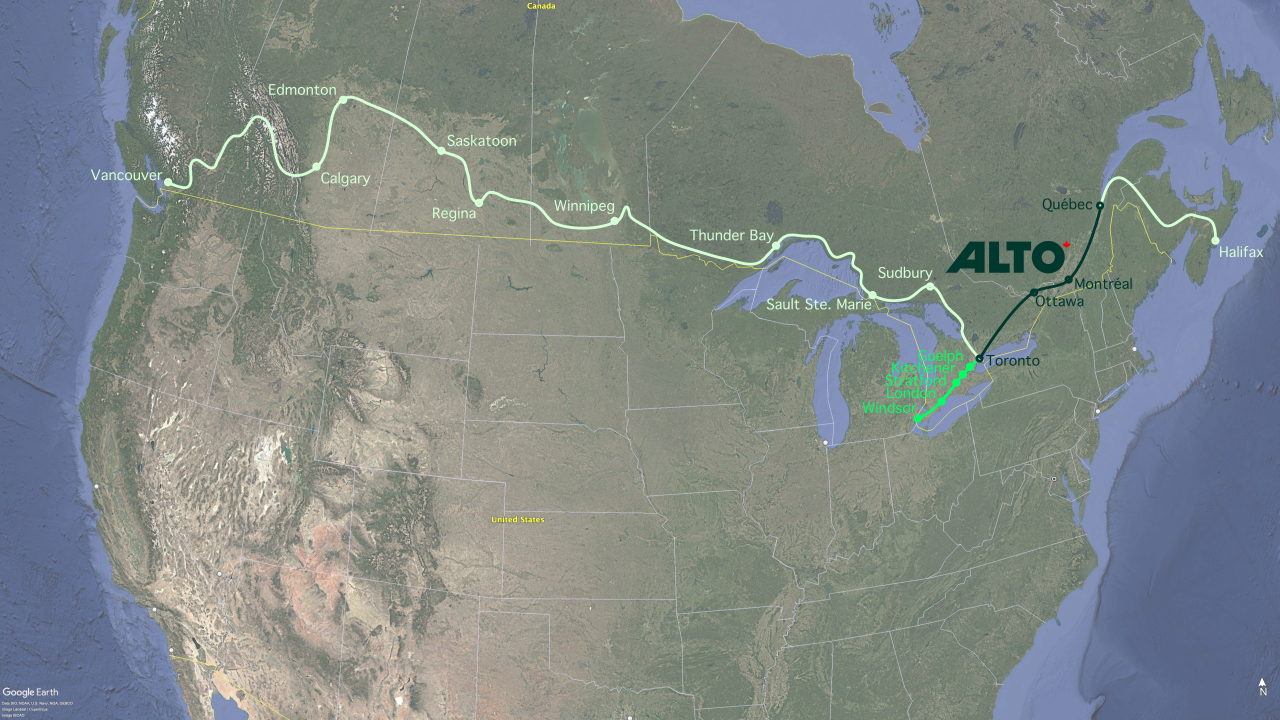
Canada takes a look at the state of their southern neighbour and realises that they need to think bigger than Québec–Toronto. They target a direct HSR corridor Halifax–Vancouver, completely on Canadian soil.
In a move that may upset Gareth Dennis2, they aim to do this all at once, rather than staged/phased projects.
Unlike the current Alto proposals, where ground is broken on the first 200km stretch in 2029 and the through route won’t be complete until the mid-2040s at the earliest, Canada targets through trains from Halifax to Vancouver in a decade.
To enable this, they bring in huge numbers of Chinese HSR experts (the only place to manage a such rapid HSR rollout) to kickstart the process, but train a huge cohort of Canada-native HSR engineers who can deliver the bulk of the project.
In addition to the main through route, they also add a branch southwest from Toronto to Windsor, with an Austrian-style mixed-traffic 250km/h service.
Phase 2
Meanwhile south of the border, the culture of the class 1 railways continues to get sicker following the Union Pacific/Norfolk Southern merger eliminating competition, to the point that they collapse in on themselves. Canadian National (or Canadian Pacific, I don’t know enough about Canadian railway politics to guess) buys them out, funded by a low-interest Canadian government loan (with non-public strings attached).
You might think that the intelligence community would be opposed to critical US infrastructure being owned by the Canadian government, and under any other administration you’d be right, but this one isn’t paying enough attention to notice.
One of the strings is the electrification of the entire network, giving work to the electrification engineers as they finish up their segments of the trans-continental Alto.
While the initial investment is heavy, this rapidly turns into a huge revenue stream for Canada as the operating cost drops and reliability increases.
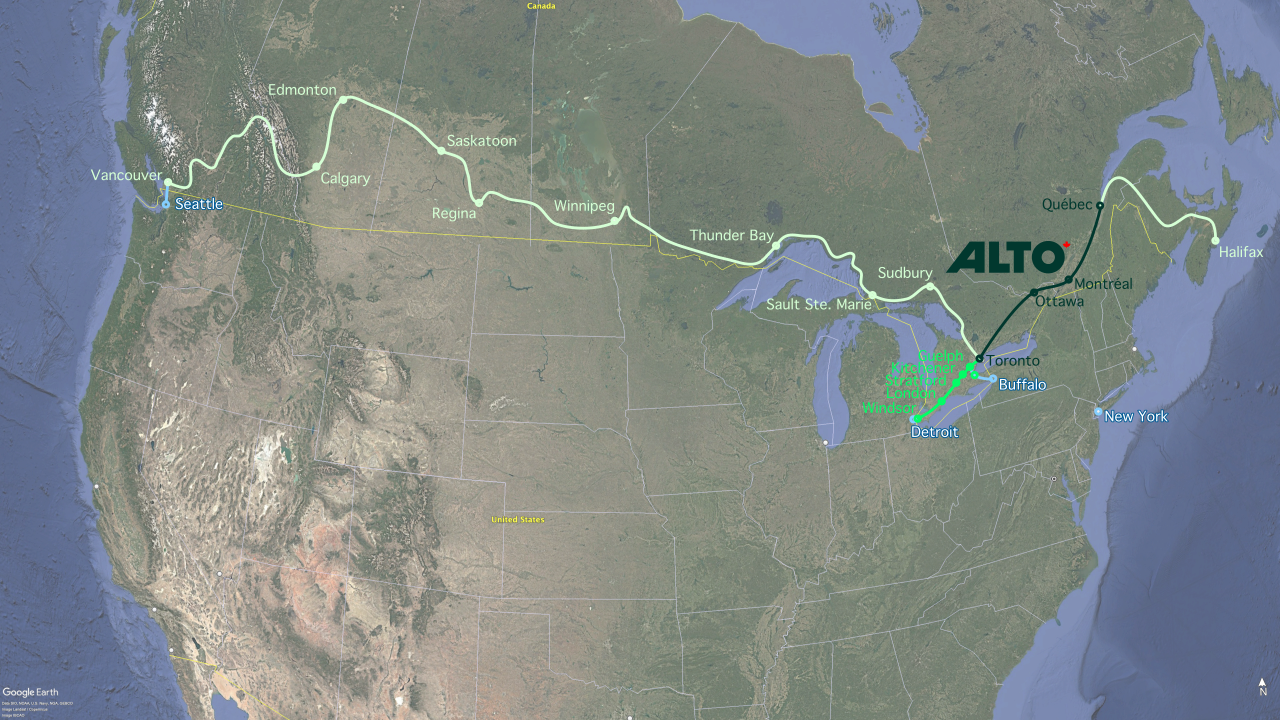
Meanwhile, the increasingly xenophobic US government stops Amtrak running services to Canada. In response, Alto extends to Vancouver–Seattle, and Windsor–Detroit, and Hamilton–Buffalo, and VIA Rail takes over the slower international services.
Due to US border paranoia, all international stations now have Eurostar-style juxtaposed controls.
Phase 3
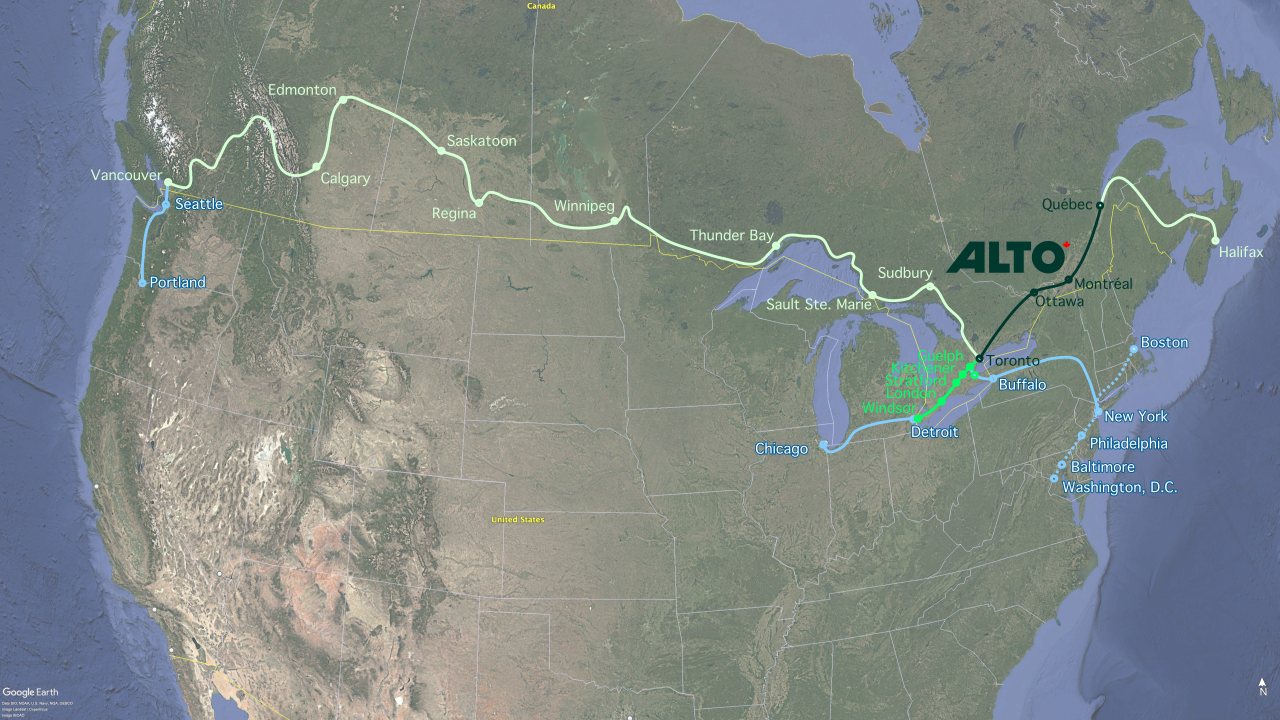
Having more money flowing in than ever from the increasingly efficient freight railroads, the Canadian government through Canadian National/Pacific, VIA Rail, and the Ontario Teachers’ Pension Plan (somehow they get their fingers into every infrastructure project) fund high-speed expansion Seattle–Portland, Detroit–Chicago, and Buffalo–NYC, (with through service onto the Northeast Corridor for the latter).
From here, extensions are then developed further south to Sacramento, Los Angeles, Las Vegas California, and Tijuana Mexico in the west (with the latter allowing through connections from Mexico without passing US border control); St. Louis Missouri, Little Rock Arkansas, and Dallas–Fort Worth, Austin, and San Antonio Texas in the centre, with an additional connection from Winnipeg to Chicago via Minneapolis Minnesota; and Richmond Virginia, Charlotte North Caroline, Greenville South Caroline, Atlanta Georgia, and Orlando, Tampa, and Miami Florida in the east (and an extra direct connection from Montréal to New York). All, of course, offer through services to Canada.
The latter proves very popular with Canadian retirees, who are well-known for spending their winters in the warm southeast. All are popular with Americans, who can now make far more journeys without needing to suffer through airports. The electrification of the existing freight lines means that far more passenger services can be run on those, too, feeding into the high-speed routes from cities not directly served, and spurring a rail renaissance and a virtuous cycle of increased passenger demand (and farebox revenue).
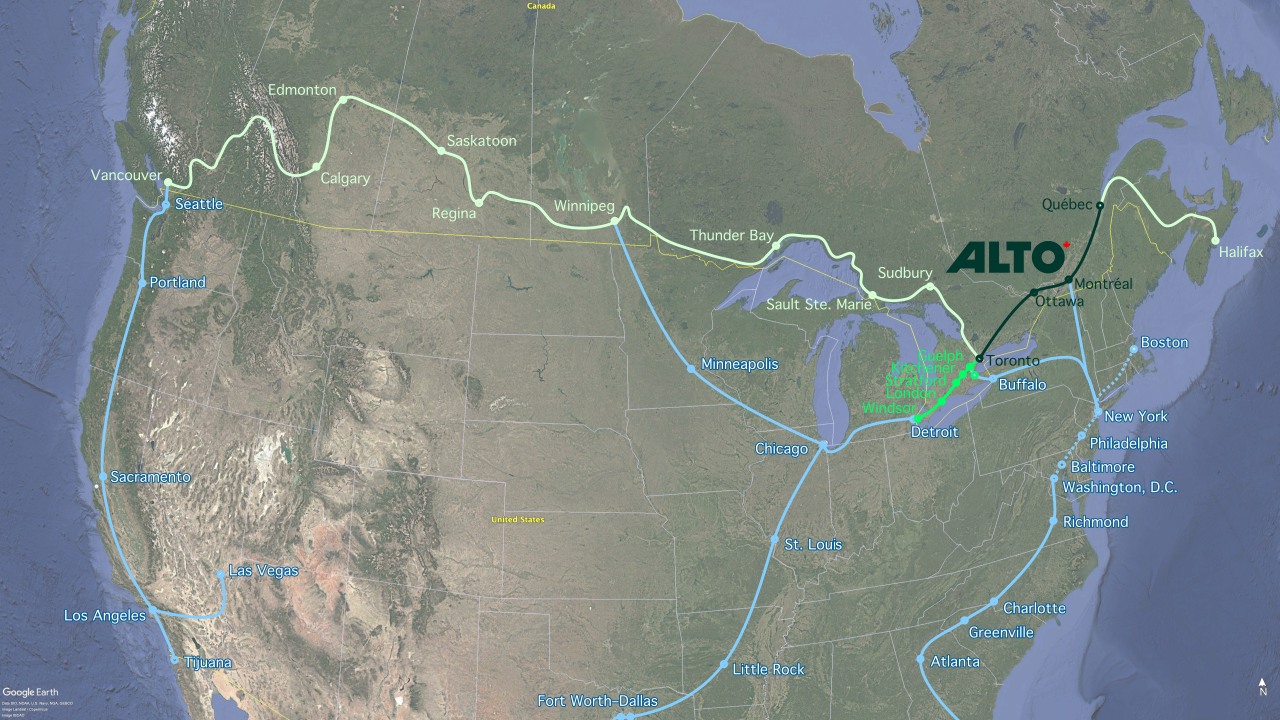
Some rail experts describe the design as extractive, with lines arranged to get passengers out of the US into Canada; this however is an inevitable consequence of the project being run out of Canada. The Canadian government and railroads are less interested in east-west traffic across the USA, especially when they already have a serviceable east-west line further north.
The plot thickens
As I’m not much of a speculative fiction author, this is where things get a little sketchy. But at some point, the US decides to turn the screws on its citizens. However, Canada now has border crossing points in twenty US states, and almost every major population centre.
Should the US see the mass exodus of its citizens, huge crowds seeking asylum at each high-speed rail station, and decide to turn its hostility to the railway itself, it may be surprised to find that the railway has a standing army of thousands of engineers, positioned to be able to rapidly deal with any failure in the network. (This was of course “intended” as a defence against natural failures, rather than government sabotage!) They are supported by a vast rail logistics network, able to rapidly transport necessary materiel from across the border when necessary.
Conclusion
Train good…
If anyone wants to take this concept and develop it into a more fully-formed story, or otherwise play around with the setting, feel free!
Likewise, if anyone wants to fund buying large amounts of North American railroad and making them work better, please do that too!
Notes
-
If this runs to time, this makes the first phase hard to cancel, assuming the next federal elections happen in October 2029. It doesn’t necessarily rule out a High Speed 2-like scenario, however, where the later phases that would actually make the entire project viable are dropped by a subsequent government, leaving an expensive white elephant behind. ↩
-
One of Gareth’s biggest criticisms of HS2 as a project is that it was set up as a huge monolithic project, meaning that costs seem much higher than other high-speed lines. ↩