Shinkansen sleeper trains
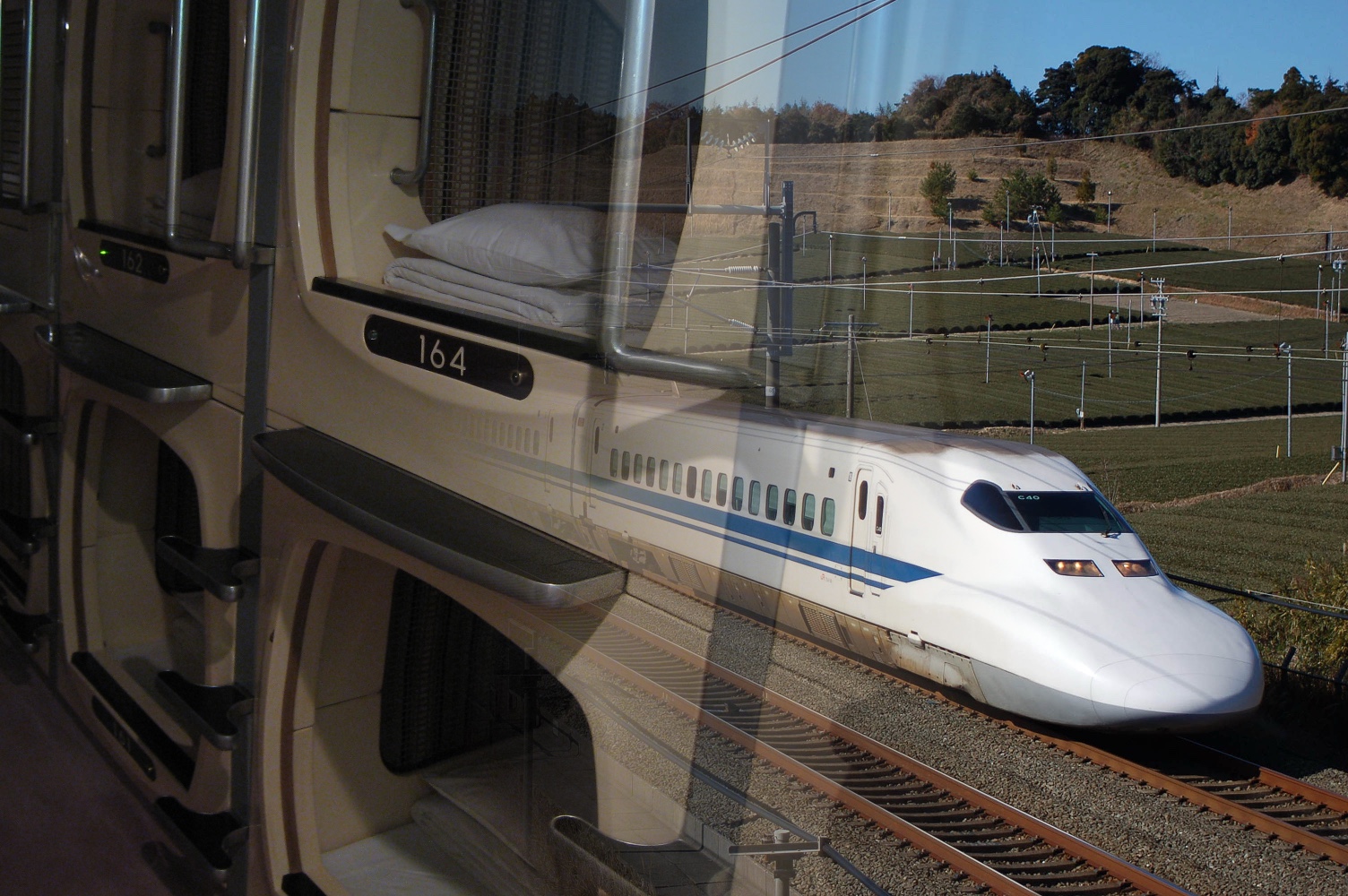
When the Shinkansen was in development in the 1960s, it was originally proposed to be a mixed-use railway line, including passenger trains, freight trains, and sleeper trains. By the time it opened, the focus had changed to operating high-speed passenger trains only. Trains stop running overnight, to allow for track maintenance. It has operated this model highly successfully for the last 60 years, and rail experts generally agree that segregating high-speed traffic from slower-speed freight and local trains gives more optimal utilisation of the infrastructure, allowing trains to run more frequently.
However, some of these basic assumptions are now being challenged. On the Tohoku Shinkansen, following successful trials, high-speed freight services have started running, making use of stripped down E3-series Shinkansen trainsets, for time-sensitive perishable goods. Using rolling stock that can run at full Shinkansen speeds and accelerations means that the timetable is less disrupted than it would be by standard freight locomotives and wagons.
Previously, special inspection trains such as Doctor Yellow would be run in-between timetabled services to inspect the infrastructure for defects. Now, these tests are done by equipment installed on regular passenger trains, allowing more intensive use of the infrastructure.
The question now is, given that we need to decarbonise, that there is a growing oil crisis thanks to geopolitical events, and that millions of passengers a year still take domestic flights in Japan, is there anything that the rail network can do to enable this, beyond what is already being done? I have previously discussed my ideal solution to this, but that requires decades of effort and tens of trillions of yen even for just the Japanese legs; it would be good to have some stop-gaps in the mean time. In particular, can something be done about the final restriction I mentioned above: that Shinkansen trains don’t run at night.
The majority of domestic flights in Japan are on routes already (or shortly to be) served by the Shinkansen: Tokyo to Osaka, Fukuoka, and Sapporo; the challenge then is to make them meet people’s needs. Spending most of a work day taking the Nozomi on its full length from Tokyo to Hakata isn’t particularly attractive to business travellers; neither is losing an entire evening of one’s own time. What if instead, one could go to sleep in Tokyo and wake up in Kyushu or Hokkaido, ready to start the next work day?
Challenging economics
In regions that can be traversed end-to-end in a day or less, there are two main modes of providing trains at night: either running regular service trains through the night (as is done by ICE trains in Germany, for example), or running dedicated sleeper trains, featuring beds and/or couchettes, allowing some or all passengers to lie down and sleep.1
Having taken a sleeper train with only a seat myself, I can say that it requires a certain amount of resilience (which I don’t have; I won’t be doing it again!). Regular high-speed trains running at night is a step beyond even this, frequently needing to change trains in the small hours, both boarding and alighting. This is at odds with the aim of providing something more convenient than flying; I don’t think running regular Shinkansen services at night will drive the change we’re looking for. So for the remainder of this article, I’ll focus on sleeper services; that is, services that use dedicated rolling stock and provide some way for passengers to lie down and sleep.
Japan has a history of sleeper services, outlined in a recent Japan Railway Journal video. Most of these have been obsoleted by the Shinkansen, and all run along Japan’s older, slower narrow-gauge network rather than along the Shinkansen lines. Their focus is primarily on tourism, providing high-end experiences to justify a higher ticket price. Using the classic network allows more destinations to be reached than can be done by Shinkansen, but this likely drives modal shift from cars rather than from flights. To enable routes that will attract passengers from flights, there must be longer routes, which will need to operate along Shinkansen lines.
In Europe, night trains have similarly declined in recent decades. This trend has reversed somewhat in the last few years, with ÖBB taking over a lot of routes previously run by other national railways, and new entrants like European Sleeper filling other gaps. A challenge that all are experiencing however is the availability of trains. A sleeper train can generally only make one journey per day and carries fewer passengers than a day train (as each needs room to lie down), and the overall number required is lower due to the smaller number of viable night routes. As such, they are more expensive to buy, but make less profit per train per year; they are difficult to pay off, even if an operating profit can be made.
Rolling stock
As such, building new sleeper Shinkansen trains from scratch is likely out of reach. However, what of the model used for the freight Shinkansen services, which are using modified E3-series trains, formerly used in passenger service on the Tohoku Shinkansen. Could we do the same thing for sleeper trains?
Unfortunately, the last E3-series trains (save for those adapted for freight services) have been scrapped, so we can’t use these as a base. However, there is another small fleet of Shinkansen trains that are in the process of being withdrawn from passenger service: currently, 16 eight-car 700 series Shinkansen trains are in use by JR West on their Hikari Rail Star and all-stop Kodama services; half of these are due to be withdrawn and scrapped by the end of 2027.2
The question becomes: how many sleeping people can we comfortably fit into an 8-car 700-series Shinkansen, and how can we do this in a cost-effective way?
A capsule hotel on wheels
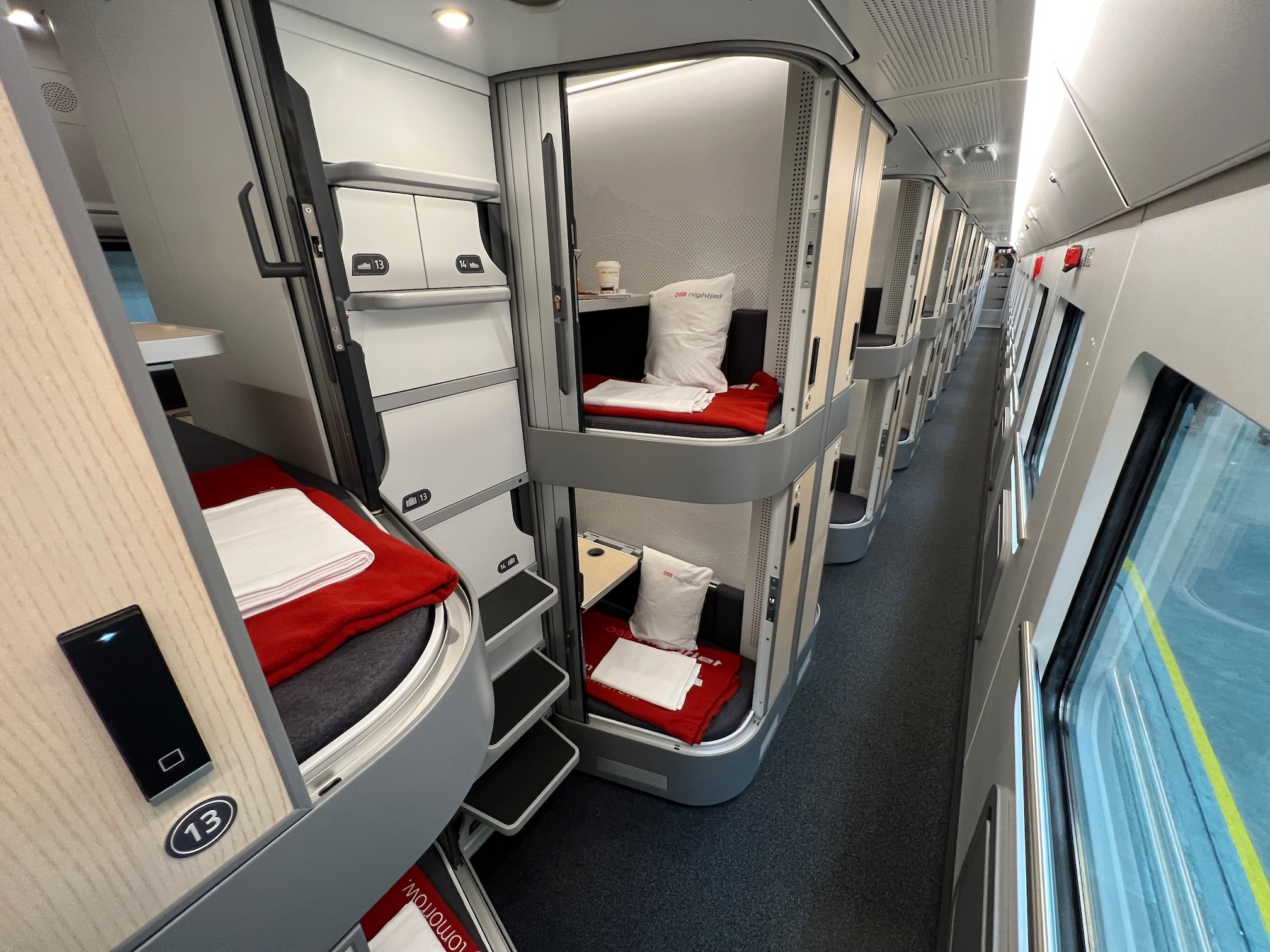
ÖBB have recently introduced their latest generation of sleeper trains, which adds a new carriage layout in addition to the traditional couchettes (shared compartments featuring four or six fold-down bunk beds) and sleeper cabins (private compartments with one to three beds): the “mini cabin” provides the privacy of a sleeper cabin but requires only the space of (and so has a fare comparable with that of) a couchette berth.
The mini cabin is the size of a small bed, with an opening at one end to climb in and out. Vertically, it has enough room to lie down or sit up. Overall, it is very reminiscent of a capsule hotel, a concept originating in Japan. Surely, then, for relatively minimal cost, JR West could acquire mass-market hotel capsules and use them to fit out one or more 700-series trainsets destined otherwise for scrap.
To answer this question precisely, one would need detailed technical drawings of each 700-series Shinkansen carriage design, with all relevant internal dimensions. Unfortunately, I haven’t been able to find these anywhere; the closest I’ve found is an unlabelled, not-quite-to-scale illustration of a single front carriage, in the book 完全保存版!新幹線まるわかりBOOK, helpfully identified by 砂漠人 on Fediverse. I’ll try and reverse some rough dimensions from this.
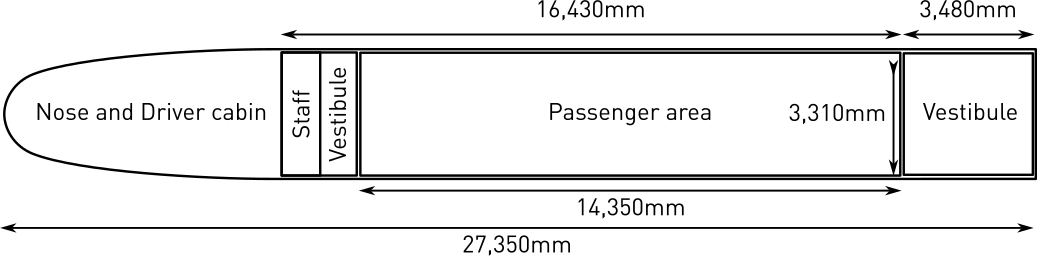
The front carriage is identified by the book as being 27,350mm long. From this, we can judge that the passenger area of the front and rear carriage are each around 14,350mm long and 3,310mm wide. Assuming a ~3.5m vestibule at each end of each carriage, the stated length of middle carriages of 25,000mm gives a passenger area of these carriages of 18,000mm. The vehicles are 3,650mm high, and the Shinkansen uses a platform height of 1,250mm, meaning that the vehicles extend 2,400mm above the floor. The interior height will be slightly lower than that, due to the thickness of the ceiling.
The standard Sleep Capsule produced by Kotobuki occupies a space of 1200mm × 2400mm × 2400mm for two capsules stacked vertically. This would be a tight fit vertically, but would allow 11 capsule pairs to be installed in the end carriages (allowing 1150mm to access the vestibule door), and 14 in the middle six carriages. Placing these at one side of the carriage would give a 910mm walkway on the other side. The curvature of the side of the train would restrict the height of the upper capsule; this would likely mean that custom capsules would be needed rather than being able to use off-the-shelf models.
At maximum capacity, then, an eight-car 700-series Shinkansen could be adapted to carry 212 sleeping passengers. In reality, however, the space of at least one stack (or two capsules) per carriage would need to be devoted to luggage storage, since one can hardly take a suitcase into a capsule. This would reduce the capacity to 196. Of course, similarly to sleeper operations in Europe and operations on the Yamagata and Akita mini-Shinkansen lines, two trainsets could be coupled together to give a capacity of 392 people. Additionally, similarly to operations in Europe, it may be preferable to leave one or two carriages with the current seating configuration, to allow for short late-night or early-morning journeys.
Routes
There are currently two natural corridors for overnight Shinkansen routes: from Tokyo west through Kansai and then south to Kyushu, and from Tokyo north to Tohoku and Hokkaido. In the former case trains could operate all the way to Kagoshima-Chuo, currently requiring 6.5 hours on the fastest services. Unfortunately, we’re still some time away from the Hokkaido Shinkansen opening all the way to Sapporo, so the furthest passengers could go is Shin-Hakodate Hokuto to the north, taking a shade under four hours. The latter route would also require adaptations to be made to the trains, which are designed for the 60Hz electrification used in West Japan; they would instead need to be able to operate on the 50Hz used in East Japan. Getting from Shin-Hakodate-Hokuto to Sapporo takes another 3.5 hours on top of the time on the Shinkansen; as such, it would seem like the northern route is more trouble than it’s worth until the Sapporo extension opens.
Operations would need to be relatively flexible. In other countries with sleeper trains, they generally have very generous timings, both to ensure they don’t arrive too early, but also to allow rerouting where lines are closed overnight for maintenance. Since the Shinkansen is an entirely linear network, the latter is not possible. One would hope that it would be possible to allow one or two services to pass a work site at night, even if it couldn’t be run with the same intensity as a day service while still maintaining good standards of maintenance; one could even consider running on the wrong line (subject to signalling allowing this); this would require significant slack in the schedule to allow trains to wait for the line to clear from oncoming trains in this instance. Given the current (zero) level of traffic on these lines at night, this is unlikely to cause disruption to other services.
A potential cause of disruption, however, is at the termini. Tokyo station has a mere four platforms serving the Tokaido Shinkansen, which are some of the most intensively operated in the world during the morning rush hour, precisely when we would like our sleeper to arrive. It wouldn’t be acceptable for the service to dwell on the platform until passengers wake up and are ready to leave, unlike, for example, the Caledonian Sleeper in the UK, which waits an hour or more after arrival. As such, the arrival should not be too early, so that passengers aren’t required to be awake at too painful a time.
Within these parameters, the following schedule seems potentially achievable:
Eastbound principal stations:
| Station | Arrive | Depart | Notes |
|---|---|---|---|
| Kagoshima-Chuo | — | 2120 | After Tsubame 338, before Tsubame 340 |
| Hakata | 2310 | 0000 | Allowing Tsubame 340 and Sakura 410 to arrive and depart on the second eastbound platform |
| Shin-Osaka | 0300 | 0350 | |
| Nagoya | 0505 | 0520 | |
| Tokyo | 0716 | Between Nozomi 9 and Nozomi 235 |
Westbound principal stations:
| Station | Arrive | Depart | Notes |
|---|---|---|---|
| Tokyo | 2208 | Between Hikari 669 and Kodama 913 | |
| Nagoya | 2350 | 0010 | |
| Shin-Osaka | 0125 | 0200 | |
| Hakata | 0500 | 0600 | |
| Kagoshima-Chuo | 0750 | Between Tsubame 305 and 307 |
In both cases, I’d suggest calling at the same stations as Sakura services from Kagoshima-Chuo to Hakata, and as Hikari from there to Tokyo, to provide some degree of local services, but be able to go fast enough near Tokyo to avoid disrupting day services.
Future routes
If and when the Nishi Kyushu Shinkansen between Takeo-Onsen and Shin-Tosu is built, then a 16-car train could split/join at Shin-Tosu, with an 8-car unit to/from Nagasaki in addition to one to/from Kagoshima-Chuo.
But there is a much more exciting extension available. Due to the differing electrification standards, and the benefit of running segregated systems, the Tohoku and the Tokaido Shinkansen tracks at Tokyo station have never been linked, so running through services from west to north Japan is impossible. However, currently in development is a proposal to link the Hokuriku Shinkansen at Tsuruga through to Shin-Osaka. Unfortunately, politics are delaying this: construction was due to start this year, but has been postponed indefinitely while the Japanese government revisits the previously-finalised decision on the route.
Since this route already requires trains to support both electrification standards, there is less barrier to permitting a connection from the Sanyo Shinkansen to the extended Hokuriku Shinkansen at Shin-Osaka (and/or, depending on the final route chosen, at Kyoto). This would allow trains to travel from west Japan, via Fukui, Kanagawa, and Nagano, to Omiya in northern greater Tokyo. From there, they could reverse to take the Tohoku Shinkansen toward Aomori and Hokkaido.3 Given the timescales required for the final leg of the Hokuriku Shinkansen, it is likely (if not guaranteed) that the Hokkaido Shinkansen to Sapporo would be complete, allowing a through service along the length of the Shinkansen network for the first time.
This would, of course, require modifications to the 700-series Shinkansen to enable using both frequencies of electricity. With the fastest services currently available, and assuming a roughly 30-minute time from Shin-Osaka to Tsuruga, this would minimally take around 11 hours; allowing additional time for possible delays during maintenance work would extend this past 12 hours, a time definitely warranting a sleeper train.
Given the longer time, and the inconvenience of making a call in Tokyo, it would seem to make sense to run this service in addition to the Tokyo service, rather than instead of it. In this case, I would anticipate the following schedules
- In early evening, a service leaves Kagoshima-Chuo and Sapporo (and possibly additionally Nagasaki), heading north and south respectively.
- In later evening, the above services depart Kagoshima-Chuo and Tokyo heading north/east and west respectively, and an additional pair of services leave Tokyo and Sapporo heading north and south respectively.
- In early morning, the services to and from Tokyo arrive at their destinations.
- Slightly later in the morning, the longer-distance services arrive.
Conclusions
A sleeper service from Tokyo to southern Kyushu and back is possible with a modest refit of the existing 700-series Shinkansen, which are shortly to be taken out of service. A capacity of 392 people per train is relatively substantial; however, it is a drop in the ocean compared to the 31,000 flight seats available daily from Tokyo to Fukuoka. A similar service from Tokyo to Hokkaido seems less viable, at least until the Sapporo extension of the Hokkaido Shinkansen opens.
If and when the Hokuriku Shinkansen’s final leg from Shin-Osaka to Tsuruga opens, it will be possible to additionally have a longer-distance service from Kyushu to Sapporo and back.
But clearly, more work is needed if we’re going to push more people out of planes and onto trains.
Notes
-
In larger territories such as the US and Russia, long-distance trains are all sleepers, with more luxurious private cabins for passengers who will be travelling for multiple days, and seats for those joining for only a short leg. Since I’ve previously discussed how one can go from one end of Japan to another in a day, I’ll not discuss these further. ↩
-
An alternative would be the 500-series Shinkansen, of which there are six, all also due to be retired by the end of 2027. These are however an older design and of an older construction date, meaning they will be harder to maintain; they less energy-efficient, so more expensive to run; and they are smaller in number, meaning that it would be harder to scale services up should they be successful. (The 700-series was designed and built to overcome these shortcomings with the 500-series.) I’ll focus on the 700-series here, but it might be worth also bearing the 500-series in mind. ↩
-
In principle, the train could also continue into central Tokyo before reversing, allowing picking up and dropping off passengers in Tokyo. However, the arrival and departure time would probably be around 3am, antithetical to being able to get a good night’s sleep. ↩